

Selecting the right B2B partnership model can determine whether your brand maintains control over pricing, prevents grey market diversion, and scales efficiently across territories. Brand owners and authorized distributors in consumer goods and industrial sectors face mounting pressure to establish structured, verified partnerships that balance growth with risk mitigation. This article examines proven B2B partnership examples, from integrated supply chain models to exclusive distribution agreements, and provides a practical framework to evaluate which approach best fits your distribution strategy and operational priorities in 2026.
Table of Contents
- Criteria To Evaluate B2B Partnerships: Control, Risk, And Scalability
- Integrated Supply Chain Partnerships: The Kenco And Blue Buffalo Example
- Digital Transformation In B2B Partnerships: Mirka's Omnichannel Portal Upgrade
- Exclusive Distribution Models: Benefits, Challenges, And EU Legal Compliance
- Intermediary Models In B2B Retail Distribution: Distributors Versus Agents
- Comparing B2B Partnership Types: A Side-By-Side Analysis
- Explore Verified B2B Partnerships With Chain Atlas
- Frequently Asked Questions
Key takeaways
| Point | Details |
|---|---|
| Control and risk balance | Effective B2B partnerships align distribution control with market risk management through structured agreements and verified partner networks. |
| Long-term pricing stability | Long-term agreement pricing frameworks support sustainable multi-year partnerships by balancing price adjustments with performance incentives. |
| Exclusive distribution benefits | Exclusive distribution enhances brand equity and reduces grey market risk but requires legal compliance and strong partner infrastructure. |
| Omnichannel fulfillment advantage | Integrated fulfillment partnerships increase scalability and customer satisfaction through seamless order tracking and self-service portals. |
| Strategic partner selection | Choosing partners with robust infrastructure, financial stability, and strategic alignment is critical for long-term success. |
Criteria to evaluate B2B partnerships: control, risk, and scalability
Brand owners and distributors must assess potential B2B partnerships against clear criteria to ensure alignment with strategic goals. Distribution control hinges on territorial exclusivity, partner infrastructure capabilities, and contractual governance that prevents unauthorized channel access. Long-term agreement pricing frameworks provide structured playbooks for multi-year B2B relationships to balance price, risk, and performance, helping avoid margin erosion during periods of price volatility.
Risk sharing mechanisms include performance clauses, minimum purchase commitments, and clear dispute resolution processes embedded in contracts. Scalability depends on integrated supply chain capabilities, omnichannel fulfillment infrastructure, and the partner's capacity to support growth without compromising service quality. Financial stability, compliance track record, and technological maturity round out the evaluation criteria.
When evaluating potential partners, consider these priorities:
- Pricing frameworks that accommodate market fluctuations while protecting margins
- Territorial rights and exclusivity terms that prevent channel conflict
- Infrastructure capacity for warehousing, logistics, and customer service
- Legal compliance with local regulations and competition law
- Technology platforms that enable transparency and real-time visibility
Pro Tip: Before committing to a partnership, request detailed data on the distributor's existing customer base, order fulfillment accuracy rates, and technology stack. This reveals whether they can scale with your brand and maintain service standards across territories. Access market intelligence insights to benchmark partner capabilities against industry standards.
With clear criteria defined, explore specific partnership examples demonstrating these principles.
Integrated supply chain partnerships: the Kenco and Blue Buffalo example
Integrated supply chain partnerships deliver end-to-end logistics expertise that supports rapid growth while maintaining operational control. The partnership between Kenco and Blue Buffalo fuels efficiency, scalability, and customer satisfaction across North America, showcasing how third-party logistics providers can become strategic partners rather than transactional vendors. Kenco manages warehousing, order fulfillment, and distribution for Blue Buffalo's premium pet food products, enabling the brand to focus on product development and market expansion.
This model suits brands experiencing rapid growth or entering new markets where building proprietary logistics infrastructure would divert capital and management attention. Integrated partnerships provide access to advanced warehouse management systems, transportation networks, and fulfillment expertise without the fixed costs of ownership. Speed and precision improve as specialized logistics partners optimize inventory placement, reduce order cycle times, and enhance delivery accuracy.
Key benefits of integrated supply chain partnerships include:
- Scalability without capital investment in warehouses or transportation fleets
- Access to specialized expertise in inventory management and fulfillment optimization
- Improved customer satisfaction through faster delivery and order accuracy
- Risk mitigation through performance-based contracts and service level agreements
"The partnership between Kenco and Blue Buffalo demonstrates how integrated logistics providers can become strategic enablers of brand growth, not just cost centers. By outsourcing fulfillment to a specialized partner, Blue Buffalo maintained control over brand positioning while scaling distribution efficiently."
For brand owners seeking similar partnerships, evaluate providers based on technology integration capabilities, geographic coverage, and industry-specific expertise. Explore distributor membership options to connect with verified logistics partners who understand your sector's unique requirements.
From integrated logistics, we turn to improving B2B omnichannel experience with digital platforms.
Digital transformation in B2B partnerships: Mirka's omnichannel portal upgrade
B2B partnerships increasingly include digital platform enhancements that improve customer experience and operational efficiency. Mirka redesigned its B2B customer portal with the help of KPS, starting in Spring 2020, to provide seamless omnichannel experiences for corporate customers. The upgraded portal enables order tracking, self-service account management, and real-time inventory visibility, reducing customer service inquiries while improving satisfaction.
Modern B2B portals transform transactional relationships into strategic partnerships by providing transparency, convenience, and control. Customers access order history, track shipments, manage invoices, and initiate returns without contacting sales representatives. This self-service capability reduces operational costs while freeing sales teams to focus on relationship building and strategic account management.
Benefits of omnichannel B2B portal partnerships:
- Enhanced customer experience through 24/7 self-service capabilities
- Reduced operational costs by automating routine inquiries and transactions
- Improved data visibility for both suppliers and customers
- Faster order processing and reduced error rates
Pro Tip: When evaluating potential B2B partners, assess their digital maturity by requesting demos of customer-facing portals and backend systems. Partners with modern technology stacks can integrate more easily with your systems and provide better visibility throughout the supply chain. Review the distributor onboarding process to understand how digital tools streamline partnership activation.
Partnerships may include technology providers to upgrade digital interfaces, as Mirka demonstrated with KPS. This approach allows brands to modernize customer interactions without building proprietary platforms from scratch, accelerating time to market and reducing development risk.
Next, examine exclusive distribution agreements and related legal frameworks impacting partnership choices.
Exclusive distribution models: benefits, challenges, and EU legal compliance
Exclusive distribution agreements grant sole selling rights to distributors within defined territories, creating powerful incentives for partners to invest in market development. Exclusive distribution models can enhance brand equity and reduce grey market diversion by up to 20%, according to McKinsey's 2025 beauty sector analysis. This model works best when distributors possess strong infrastructure, local market expertise, and financial capacity to support brand building activities.
Market benefits include pricing integrity across channels, enhanced brand positioning through selective distribution, and reduced grey market risk. Exclusive partners have clear incentives to protect brand equity since their territorial rights depend on maintaining standards and preventing unauthorized sales. Challenges include dependence on a single partner per territory, potential underperformance if the distributor lacks capacity, and legal compliance requirements under competition law.
The ECJ ruling in Beevers Kaas (C-581/23) enforces the 'parallel imposition requirement' protecting exclusive distributors under EU competition law. Suppliers must impose restrictions on active sales outside designated territories equally across all distributors to maintain valid exclusive distribution systems. This ruling clarifies that selective enforcement undermines the legal basis for exclusivity and exposes suppliers to competition law violations.
| Model | Control Level | Grey Market Risk | Partner Investment | Legal Complexity |
|---|---|---|---|---|
| Exclusive Distribution | High | Low | High | Medium to High |
| Non-Exclusive Distribution | Medium | Medium to High | Low to Medium | Low |
| Direct Sales Only | Maximum | Minimal | N/A | Low |
Key considerations for exclusive distribution partnerships:
- Verify distributor infrastructure capacity before granting territorial exclusivity
- Ensure contracts include performance metrics and termination clauses
- Comply with local competition law and VBER requirements in the EU
- Monitor distributor adherence to brand standards and pricing policies
"Exclusive distribution agreements create mutual commitment between suppliers and distributors, but success depends on choosing partners with the infrastructure, expertise, and financial strength to justify territorial exclusivity. Weak partners can lock brands into underperforming markets."
Brand owners should leverage platforms like Chain Atlas brand owner membership to identify verified distributors with proven track records and robust capabilities. Access to trade opportunities helps evaluate multiple candidates before committing to exclusive arrangements.
To round out our examples, understand intermediary models and their operational distinctions.
Intermediary models in B2B retail distribution: distributors versus agents
Distributors operate independently, managing inventory and customer relationships, unlike agents who act as intermediaries without ownership. This fundamental difference affects brand control, risk allocation, and partnership dynamics. Distributors purchase products, assume inventory risk, and own customer relationships, providing greater market penetration but less direct control for suppliers. Agents facilitate sales without taking ownership, maintaining closer alignment with supplier strategies but offering less market commitment.

Distributors invest in inventory, warehousing, and local marketing, creating stronger market presence and customer service capabilities. They profit from margins between purchase and resale prices, incentivizing volume growth and market development. Suppliers benefit from immediate payment upon shipment to distributors, transferring inventory risk and reducing working capital requirements. However, this model reduces direct customer access and limits pricing control.
Agents earn commissions on sales they facilitate, aligning their interests with supplier revenue goals without inventory investment. Suppliers maintain direct customer relationships and greater pricing control but assume inventory risk and fulfillment responsibilities. This model suits markets where direct relationships are critical or where distributor margins would erode competitiveness.
| Aspect | Distributors | Agents |
|---|---|---|
| Inventory Ownership | Yes | No |
| Customer Relationship | Distributor owns | Supplier owns |
| Risk Allocation | Distributor assumes | Supplier assumes |
| Compensation Model | Purchase/resale margin | Commission on sales |
| Market Investment | High | Low to Medium |
Operational impact considerations:
- Distributors provide faster market penetration but reduce direct customer access
- Agents maintain supplier control but require more supplier infrastructure investment
- Hybrid models combine elements of both for specific product lines or regions
- Choice depends on brand strategy, market maturity, and available resources
Explore distributor dashboard tools to understand how modern platforms support both distributor and agent relationships through unified interfaces. Review the distributor onboarding process to see how structured systems streamline partner activation regardless of intermediary model.
Following this operational breakdown, the next section provides a side-by-side comparison of the key partnership types discussed.
Comparing B2B partnership types: a side-by-side analysis
This comprehensive comparison summarizes key B2B partnership models to support decision-making based on your priorities and operational context. Each model offers distinct advantages and trade-offs across control, legal complexity, scalability, risk allocation, pricing stability, and infrastructure demands.
| Partnership Type | Control Level | Legal Complexity | Scalability | Risk Allocation | Pricing Stability | Infrastructure Needs |
|---|---|---|---|---|---|---|
| Integrated Supply Chain | Medium | Low to Medium | High | Shared | Medium | High (provider-owned) |
| Digital Omnichannel | Medium to High | Low | Medium to High | Shared | Medium to High | Medium (technology focus) |
| Exclusive Distribution | High | Medium to High | Medium | Distributor-heavy | High | High (distributor-owned) |
| Distributor Model | Medium | Low to Medium | High | Distributor assumes | Medium | High (distributor-owned) |
| Agent Model | High | Low | Low to Medium | Supplier assumes | High | Low to Medium (supplier-owned) |
Integrated supply chain partnerships excel in scalability and operational efficiency but require careful partner selection to maintain quality standards. Digital omnichannel models enhance customer experience and data visibility, making them ideal for brands prioritizing transparency and self-service capabilities. Exclusive distribution maximizes territorial control and brand equity protection but demands rigorous partner vetting and legal compliance.
Distributor models provide rapid market penetration with lower supplier infrastructure investment, while agent models preserve direct customer relationships at the cost of scalability. Hybrid approaches combining elements from multiple models can address complex market requirements or phased expansion strategies.
Consider your brand's current stage, available resources, and strategic priorities when selecting partnership models. Early-stage brands may prefer agent relationships to maintain control while learning markets, whereas established brands scaling rapidly often benefit from distributor or integrated supply chain partnerships. Explore business partnership opportunities to connect with verified partners across these models.
After reviewing the comparison, guide readers toward actionable next steps with a relevant platform offering.
Explore verified B2B partnerships with Chain Atlas
Chain Atlas connects brand owners and authorized distributors with verified B2B partnership opportunities designed to enhance distribution control and mitigate market risks in 2026. Our platform replaces fragmented trade channels with a structured ecosystem where every participant is verified, profiles are detailed, and partnership requests undergo review before approval. This approach ensures you connect with serious industry players committed to sustainable growth and controlled market access.
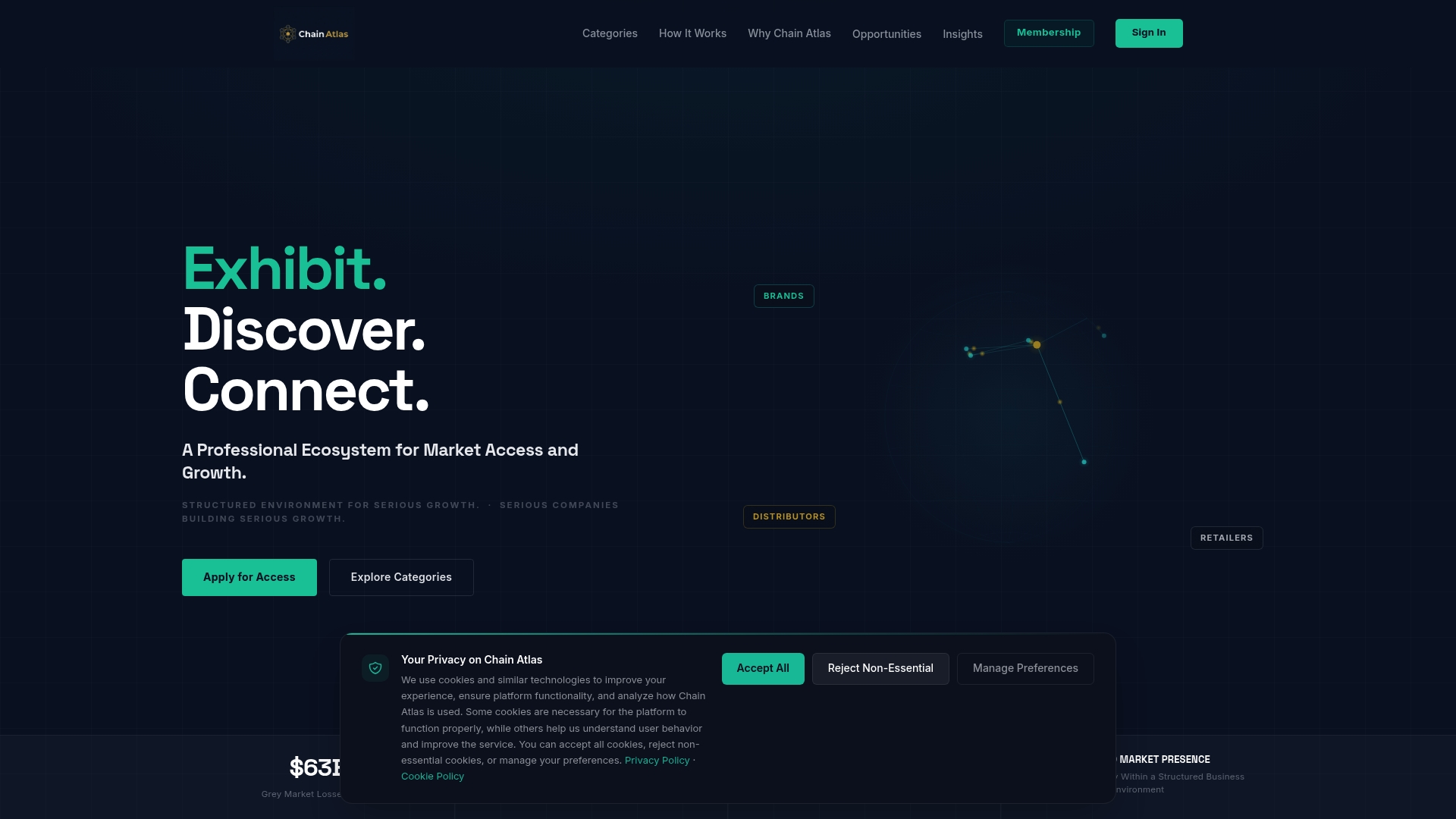
Membership options provide access to exclusive trade opportunities, onboarding support, and tools to define distribution policies and evaluate partnership requests. Whether you're a brand owner seeking brand owner membership to expand into new territories or a distributor exploring distributor membership to represent premium brands, Chain Atlas delivers the infrastructure and network to build long-term, mutually beneficial partnerships. Leverage our platform to strengthen your distribution control, prevent grey market diversion, and scale strategically across consumer goods and industrial sectors.
To conclude, common questions about B2B partnerships are answered in the FAQ.
Frequently asked questions
How do long-term agreement pricing frameworks benefit B2B partnerships?
Long-term agreement pricing frameworks help balance price stability with risk sharing over multi-year deals, providing clarity on price adjustment mechanisms tied to market indices, volume commitments, or performance metrics. These frameworks reduce the frequency of contentious renegotiations by establishing transparent formulas that both parties understand from the outset. They also support investment decisions by providing predictable cost structures, enabling distributors to commit to market development activities and suppliers to plan production capacity. Access market intelligence insights to benchmark pricing frameworks against industry standards and ensure your agreements remain competitive.
What legal considerations affect exclusive distribution agreements in the EU?
The ECJ ruling in Beevers Kaas clarified the 'parallel imposition requirement' under the Vertical Block Exemption Regulation, requiring suppliers to impose restrictions on active sales outside designated territories equally across all distributors. This means you cannot selectively enforce territorial protections for some distributors while allowing others to sell freely across borders, as this undermines the legal basis for exclusive distribution systems. Compliance requires consistent contractual terms, uniform enforcement of territorial restrictions, and documentation demonstrating equal treatment. Failure to meet these requirements exposes suppliers to competition law violations and potential challenges from disadvantaged distributors.
How can brands select the right exclusive distributor partner?
Brands should select exclusive distributors with strong infrastructure, expertise, and financial stability to justify the territorial commitment inherent in exclusivity. Evaluate candidates based on warehouse capacity, logistics capabilities, existing customer relationships, and track record in market development. Ensure alignment on brand standards, pricing policies, and legal obligations before granting exclusivity, as reversing these arrangements can be costly and time-consuming. Request detailed business plans showing how the distributor will develop the territory, including marketing investments, sales team structure, and customer acquisition strategies. Leverage brand owner membership to access verified distributor profiles and evaluate multiple candidates systematically.
What distinguishes distributors from agents in B2B partnerships?
Distributors buy and resell products, owning inventory and customer relationships, while agents act as intermediaries without ownership, facilitating sales on behalf of suppliers. This fundamental difference impacts control, risk allocation, and contractual relationships. Distributors assume inventory risk and profit from resale margins, providing market penetration but reducing supplier control over pricing and customer interactions. Agents earn commissions without inventory investment, maintaining closer supplier alignment but offering less market commitment. Your choice depends on brand strategy, market maturity, available resources, and desired control levels. Explore distributor dashboard tools to see how modern platforms support both models through unified management interfaces.